How Seven Years of Runway and the Rise of AI Changed the Way I Think
by Wim Dijkgraaf, Founder & CEO of Quotation Factory
Most founders will recognise this.
You start a company with a big vision…
and for the first years, almost all your decisions are driven by one brutal, simple metric:
Runway – how many months of cash you have left before you’re out.
That’s exactly what my life looked like in the early years of Quotation Factory.
At the same time, something else was happening in the background:
AI went from “nice theory in research papers” to “ChatGPT in your browser”.
It would be easy to assume:
“Great, AI will start doing part of the thinking for us.”
What actually happened to me was the opposite. Here is the key insight it took me years to arrive at:
AI is very good at going along with your thinking. It is much less good at challenging it.
Adding AI to your workflow does not automatically make you think more clearly. If anything, it can make you think less critically - accelerating your existing assumptions rather than questioning them. The antidote is deliberate: understand your own thinking palette first, identify your natural patterns and blind spots, and then use AI as a guided sparring partner rather than a fast yes-machine.
What follows is how I got there - and why it matters for manufacturing leaders navigating the AI era.
Life Under Runway: Survival Mode Thinking
When we started Quotation Factory, one concept coloured almost every decision I made:
Runway – how many months of money are left in the bank while your monthly revenue is still lower than your monthly costs.
In practice that meant:
- Most of our money went into:
- product development,
- figuring out how to sell,
- marketing,
- customer success,
- and keeping the whole thing hosted and running.
- Subscription revenue lagged behind the cost of building and learning.
- When the runway shrank, the only options were:
- cut costs, or
- raise new investment.
That reality puts your brain in survival mode.
You start thinking in very short cycles:
- What can we build quickly and ship as a minimum viable feature?
- Where are the quick wins?
- How do we get feedback as fast as possible, so we don’t waste development on things nobody uses?
It made my thinking very binary:
- Do we build this or not?
- Do we take this customer or not?
- Do we say yes or no to this feature request?
There was little room for nuance or long-term reflection.
Yes, there was a roadmap and a long-term strategy,
but survival always had the casting vote.
That’s the first big lesson:
When you’re dominated by runway, your “thinking palette” becomes narrow:
very decisive, very fast, very black-and-white.
Then AI Arrived: The Promise and the Trap
We started Quotation Factory in a time when there were no large language models.
No ChatGPT.
No generative AI writing your emails or summarising your meetings.
Fast forward a few years: generative AI is everywhere.
- Tools that write text.
- Tools that brainstorm ideas.
- Tools that analyse data and documents.
I was an early adopter.
And I really believed for a while:
“Finally – a part of my thinking can be automated.
Fewer headaches, more clarity, more speed.”
But as I used AI more and more, I realised something uncomfortable:
AI is very good at going along with your thinking.
It is much less good at challenging it.
The way you formulate your question and the assumptions baked into it
heavily steer the answer.
If I think in a certain direction, AI tends to reinforce that direction.
The risk is:
- You get a lot of text.
- It sounds logical.
- You feel productive.
…but you may not actually be doing critical thinking.
You can easily end up in a “smart-sounding bubble” –
where AI makes you feel sharper,
while in reality you’re questioning yourself less.
Hitting Pause: Rediscovering My Own Thinking
A few months ago, I decided to hit pause.
I literally took time away,
on an island in nature,
to get distance from the day-to-day.
I realised something simple but important:
I needed to understand my own way of thinking
before I could responsibly use AI as a thinking partner.
Over the years I had already made changes in my habits.
For example:
- I used to get my best ideas under the shower.
- Later I started walking at least two hours a day.
- But then those walks slowly turned into “podcast consumption time” with a headset on.
Podcasts and videos are great for inspiration,
but they don’t replace quiet, original, critical thinking.
So I had to “unlearn” certain habits:
- Less passive listening.
- More space to think without input.
- More reflection on how I think, not just what I’m thinking about.
That led me to a new question:
What is actually my natural thinking palette?
Which patterns do I use all the time – almost automatically?
And where are my blind spots?
Building a Critical Thinking Toolkit
From there, I went looking for thinking styles and critical thinking models
that could help me see my own blind spots –
and that I could also use to guide AI.
Two examples that came very naturally to me:
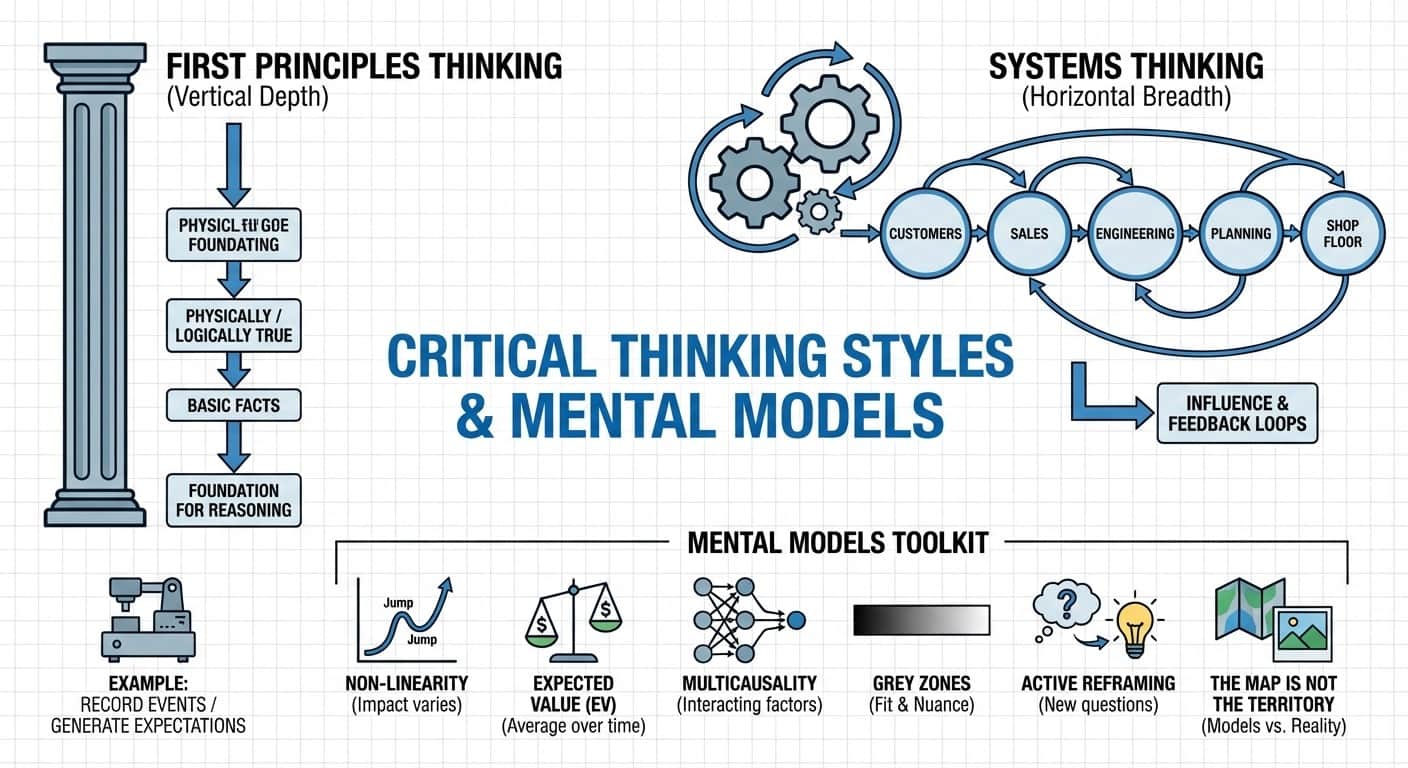
1. First Principles Thinking – Vertical Depth
This is about stripping a problem down to the most basic facts.
- If you remove all assumptions and habits,
what remains that is physically or logically true? - Those become your pillars – the foundations for all further reasoning.
In manufacturing terms, an example might be:
Events are about what has happened.
Expectations are about what we think will happen.So we need processes that reliably record events (what actually happened)
and processes that generate valid expectations (planning, promises, lead times)
– and then we need to connect those two.
First Principles goes deep: vertical pillars down into reality.
2. Systems Thinking – Horizontal Breadth
Where First Principles goes vertical, Systems Thinking goes horizontal.
You don’t just look at one machine, one order, or one department.
You look at the whole system:
- How do customers, sales, engineering, planning, and the shop floor influence each other?
- What happens to delivery reliability if you change something in the way you quote?
- Where are the feedback loops in your chain – also with suppliers and customers?
And from there I expanded my toolkit with more “mental models”:
-
Non-linearity
Not assuming: “If I do 10% more, I get 10% more result.”
Sometimes a small change has huge impact.
Sometimes you pull very hard and nothing moves. -
Expected Value (EV)
Not asking: “Did this work once?”
But: “If I made this decision 100 times,
would it still be a good bet on average?” -
Multicausality (Hickam’s Dictum)
In delivery reliability, there is almost never one root cause.
Late drawings, changing priorities, machine downtime,
supplier issues – they interact.
Especially in high-mix, low-volume environments. -
Grey zones instead of black-and-white
Not: “This customer is good / bad.”
But: “For which work is this customer a good fit, and for which not?”
The same for your own platform: where is it a perfect fit, where not? -
Active reframing
Constantly reformulating the question.
Not: “How do we work harder?”
But: “How do we become more productive?”
Or: “How do we create more value with the same hours?” -
The map is not the territory
Your ERP, KPIs, planning boards – they are maps.
Reality on the shop floor is the territory.
AI also works with maps (models).
They are useful, but never 100% the same as reality.
These are not academic toys for me.
I’ve started using them very practically as a checklist
for my own thinking – and for working with AI.
Using AI as a Thinking Partner – Not a Thinking Replacement
Once I had this clearer thinking palette,
I could also use AI in a very different way.
Instead of:
“AI, tell me what to do.”
I now ask:
“AI, help me explore this problem through a specific lens.”
Concrete examples:
- “Give me three ways to look at this issue from a Systems Thinking perspective.”
- “List the assumptions I’m probably making here.”
- “Give me only arguments why this might not be a good idea.”
- “Analyse this situation using multicausality – what combinations of factors could be at play?”
In other words:
- I use AI to generate variants of thinking,
- and I use my critical thinking models as a steering wheel and quality check.
Because I’ve noticed:
Left on its own, AI mainly confirms what I already think.
Guided intentionally, AI becomes a much better sparring partner.
Why This Matters for Manufacturing Leaders
If you run a high-mix, low-volume manufacturing company
– especially in metalworking –
AI is either already on your radar,
or it soon will be.
You’ll see it in:
- quoting,
- planning,
- engineering support,
- decision support for make-or-buy,
- dashboards and analysis.
The temptation is to think:
“Great, AI will take over a part of the thinking
so I can focus on other things.”
My experience is:
The more AI enters your environment,
the more important your own way of thinking becomes.
Because:
- AI works with models (maps), not with reality itself.
- It will happily follow the direction of your question.
- It will rarely say: “Stop. Your entire framing of the problem is wrong.”
That means:
- You need to know your own natural thinking style.
- You need to recognise where you are too black-and-white.
- You need ways to systematically explore root causes, scenarios, and trade-offs.
Not to make things complicated,
but to make sure AI is actually helping you think better
instead of simply accelerating your existing biases.
A Different Question to Ask About AI
Most conversations I hear in the market are about tools:
- “Which AI system should we use for quoting?”
- “Can we integrate ChatGPT into our ERP?”
- “What is the best AI copilot for our engineers?”
Those are relevant questions.
But I think there’s a question that comes before that:
“Which ways of thinking do we need to develop
so that AI can really strengthen us as a team?”
At Quotation Factory, this is exactly where we spend a lot of time:
not only on software and automation,
but on how commercial and technical thinking connect,
how input is structured,
and how AI can support – not replace – human judgement.
If you recognise parts of my story in your own situation,
or you’re curious how these thinking models could help in your quotation and order-intake processes,
I’d be happy to continue the conversation.
For now, I’ll leave you with this:
AI will not replace your thinking.
It will amplify whatever thinking is already there.The real leverage is not in the tool,
but in the operating system between your ears.
And that’s something we, as manufacturing leaders,
can and should keep upgrading.