The Next Step in Supply Chain Integration: From Digital Messages to Intelligent Collaboration

The Next Step in Supply Chain Integration: From Digital Messages to Intelligent Collaboration
Metalworking companies are becoming increasingly digital.
Machines are getting smarter. ERP systems are being configured more effectively. Quotation processes are being automated. More and more companies are looking at AI, agents, and self-service portals.
But inside the supply chain itself, much of the work still happens in an old way.
An inquiry arrives by email.
A drawing is attached as a PDF.
A STEP file is forwarded.
Specifications are scattered across documents, comments, and assumptions.
And as soon as an operation is outsourced, the real work begins.
Because someone has to understand what is actually being requested.
Not only technically.
Also commercially.
Process-wise.
And above all: fit for purpose.
That is exactly what the next step in supply chain integration is about.
Not just sending messages digitally.
But making sure the right information reaches the right party, at the right moment.
The Problem Is Not That Companies Do Not Communicate Digitally
Many companies think supply chain integration is mainly about replacing email.
That makes sense. Email is slow, error-prone, and unstructured. Especially when inquiries, drawings, revisions, supplier questions, and prices all get mixed together.
But email is not the real problem.
The real problem is that commercial and technical information in the chain is often not structured enough to be processed reliably.
A machine builder sends an inquiry to a metalworking company.
The metalworking company outsources a surface treatment.
The surface treatment specialist receives a request with a drawing, a few specifications, and perhaps a number such as coating thickness.
But where did that number come from?
Does it relate to corrosion class?
To lifetime expectancy?
To indoor or outdoor use?
To chemical exposure?
To regulations?
To the functional purpose of the product?
Often, the direct requester does not fully know. The information is located earlier in the chain, for example with the OEM or in product documentation.
As a result, the chain too often works on assumptions.
Not because people are careless.
But because the system is designed that way.
How Companies Work Today
In practice, the process often looks like this.
A customer sends an inquiry.
The supplier interprets drawings, 3D models, and comments.
When outsourcing is involved, documents are forwarded to a specialist, for example for powder coating or galvanizing.
That specialist assesses whether the specification is sufficient.
When there is doubt, questions move back through the chain.
Sometimes those questions are answered.
Sometimes people assume it will be fine.
That works as long as people know each other well, products are not too complex, and exceptions remain limited.
But as volumes grow, specifications vary, or multiple parties become involved, friction appears.
Quotations become slower.
The risk of errors increases.
Discussions arise afterwards.
And valuable knowledge remains locked inside people’s heads, documents, and separate systems.
That is why Quotation Factory focuses on automating and structuring the quotation process: from inquiry interpretation and reliable estimation to supply chain integration, self-service, and ERP/CAM integrations. The goal is not just faster quoting, but above all working more consistently, more scalably, and with less dependence on manual interpretation.
SCSN as a Communication Channel in a Broader Digital Chain
Within this development, SCSN, the Smart Connected Supplier Network, plays an important role.
SCSN enables companies in the manufacturing industry to exchange digital messages in a standardized way. Think of inquiries, quotations, and orders.
For Quotation Factory, SCSN is therefore not a standalone goal, but a communication channel within a broader omnichannel approach.
A customer can communicate by email.
Through a self-service portal.
Through a connector.
And soon also through SCSN.
This means the factory does not become dependent on one channel. Instead, it becomes easier to reach, easier to integrate with, and easier to scale.
In the livestream, Wim Dijkgraaf explained that Quotation Factory is involved in SCSN as a service provider and, within the Manufacturing-as-a-Service work package, is working on supply chain integration between metalworking companies and surface treatment specialists, especially around powder coating and galvanizing.
Why Standardization Matters
SCSN is based on UBL: Universal Business Language.
That matters because UBL does not only describe what a message looks like. It also defines the language, roles, and process steps in a business process.
Who is the buying party?
Who is the selling party?
What is an RFQ?
What is a quotation?
What is an order?
Which responsibility belongs to which document?
That may sound abstract, but in practice it is very concrete.
A machine builder can be the buyer when outsourcing work to a metalworking company.
That same metalworking company can then become the buyer when outsourcing galvanizing or powder coating to a surface treatment specialist.
The process basically remains the same. Only the role changes.
That is powerful because automation becomes much easier when the process does not need to be reinvented every time.
But Not Everything Belongs in the Standard Message
This is where it gets interesting.
When standardizing messages, there is a natural tendency to put more and more information into the message itself.
If a surface treatment specialist needs information, why not include all of it in the SCSN or UBL message?
The answer: because that solves the wrong problem.
A UBL message should mainly capture what is needed to create a business commitment: inquiry, price, delivery time, conditions, order, and delivery.
But technical documentation such as STEP files, CAD models, production drawings, and PDFs already exists in its own standards. You should not try to model that again inside a message standard.
A STEP AP242 file, for example, can contain geometry, product information, tolerances, and manufacturing information. It would be unwise to rebuild that domain inside SCSN.
That is why the principle here is separation of concerns.
Let UBL do what UBL is good at: structuring the business process.
Let technical files do what technical files are good at: carrying product information.
And use attachments where that makes sense.
This prevents the chain from building a new complex standard on top of existing standards that are already difficult enough to adopt widely.
The Minimum Information Set Versus the Real Knowledge Question
In customer conversations around galvanizing and powder coating, an important insight emerged.
To perform an operation, a specialist sometimes needs only a few minimum data points.
For example, a coating thickness.
A material indication.
A process variant.
A few practical specifications.
But behind those few fields, there is often a much larger knowledge question.
Why does the coating thickness need to be this value?
Where will the product be used?
What is the expected lifetime?
Which environment applies?
Which standard is relevant?
Is the part structural, cosmetic, or safety-critical?
These are not just input fields. They are domain questions.
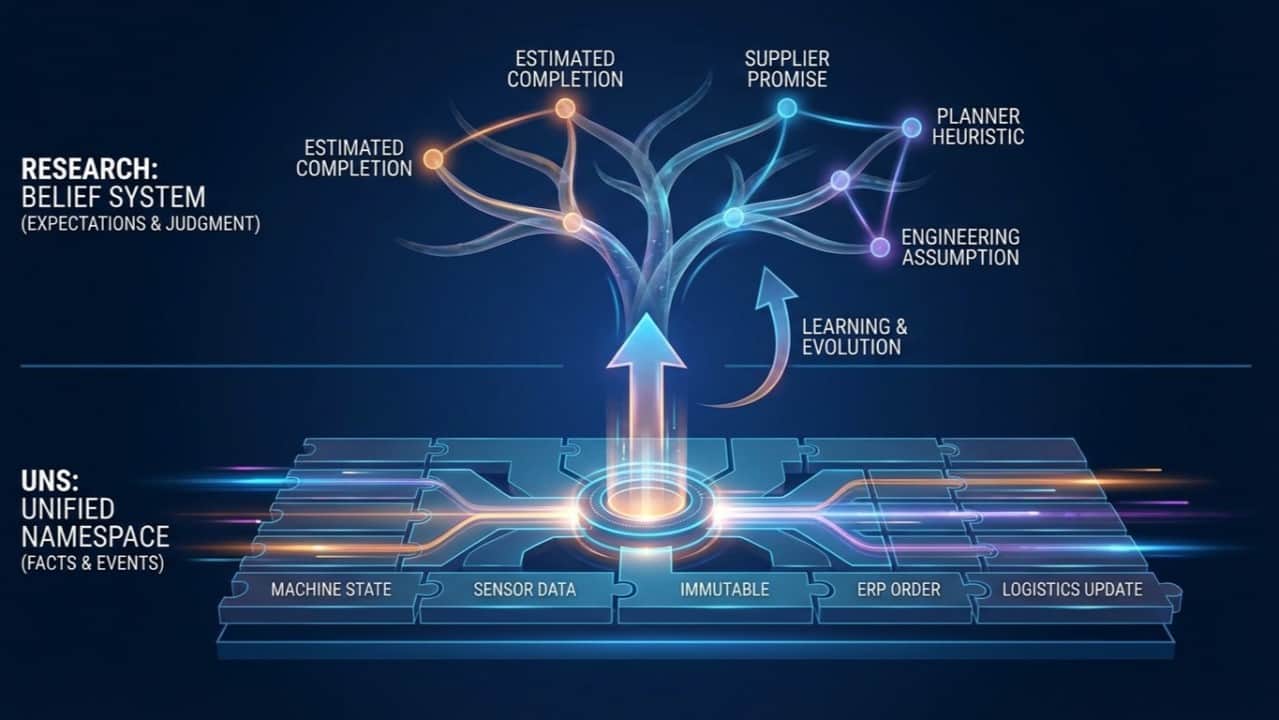
And that is where the difference emerges between a standard message and a knowledge system.
A standard message records the agreement.
A knowledge system helps determine what the right agreement should be.
The Role of Expert Systems and AI Agents
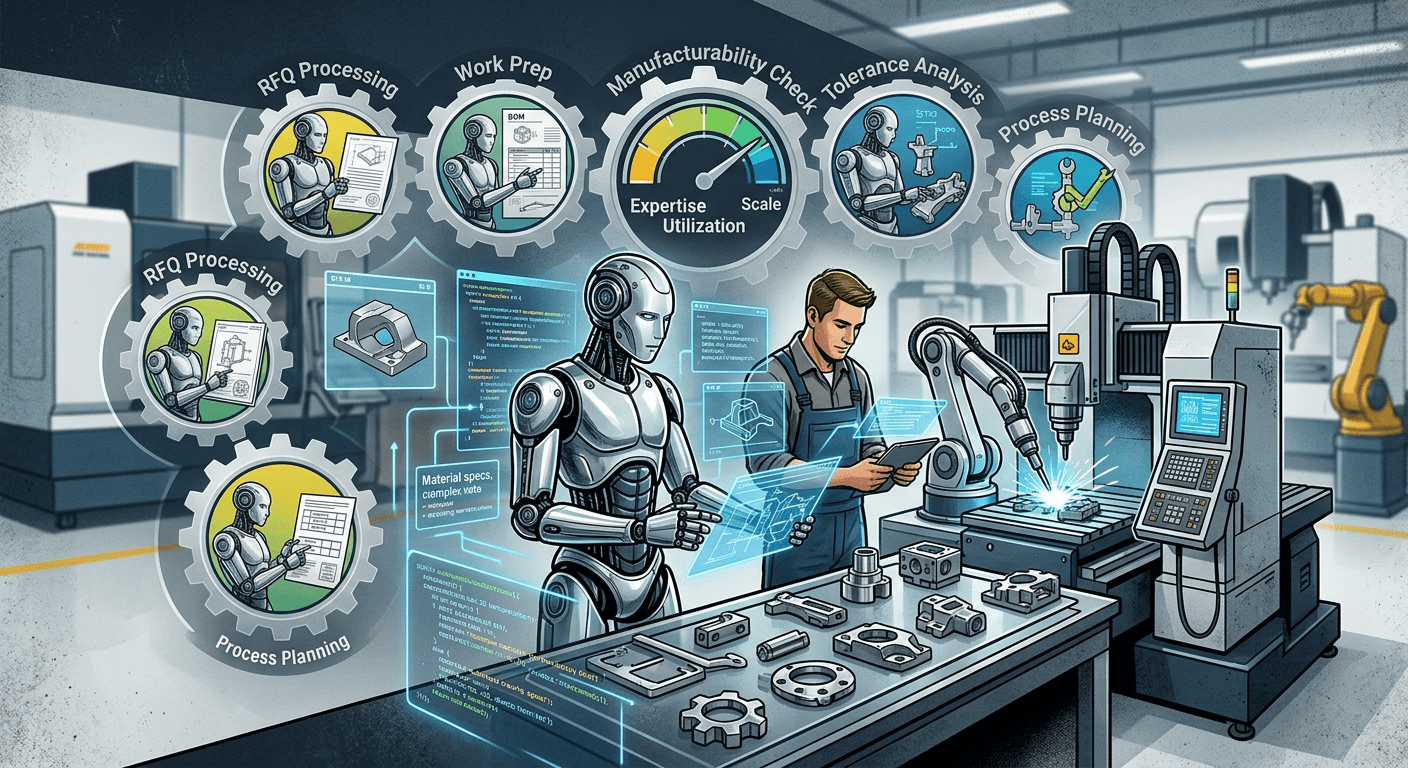
That is why Quotation Factory develops knowledge systems for technical domains such as welding, assembly, and surface treatment.
Such a knowledge system contains structured domain knowledge. It can ask relevant questions depending on previous answers. It knows, for example, that aluminum must be treated differently from steel, or that a high carbon content affects process risks.
These systems are not meant to add extra complexity.
They are meant to make expertise scalable.
Today, a person often has to think of which question is still missing. Tomorrow, an agent, supported by a knowledge system, can ask that question automatically.
Not to just anyone.
But to the right agent, at the right company, in the right place in the chain.
That changes the nature of supply chain integration.
Companies no longer only send documents to each other.
They allow systems with domain knowledge to collaborate.
Why Agent-to-Agent Communication Can Change the Supply Chain
In today’s supply chain, a lot of information is exchanged because people are not sure where the answer is.
So we send drawings, PDFs, emails, comments, and attachments back and forth.
But imagine that an agent from the surface treatment specialist can ask a question to an agent from the metalworking company. And that agent can, where needed, ask further questions towards the OEM or the product system where the original application is known.
Then not every document has to travel through the whole chain.
The specialist does not have to guess.
The requester does not have to interpret everything manually.
Sensitive or unnecessary information does not need to be shared without reason.
The chain then becomes not only faster.
It becomes more precise.
And more importantly: specifications become better connected to the real purpose of the product.
The Causal Chain
When commercial and technical input is structured, the inquiry process becomes predictable.
When the inquiry process becomes predictable, quotations can be processed faster and more consistently.
When standards such as UBL and SCSN are used for the process, companies can exchange messages safely and reliably.
When knowledge systems ask the domain questions, specifications become better substantiated.
When agents can find each other in the chain, information no longer has to travel blindly through documents and emails.
And when the right specification surfaces faster, a chain emerges with fewer errors, less waste, and more trust.
That is the real promise.
Not digitalization for the sake of digitalization.
But a chain in which companies remain free in their own workflow, while collaboration between them becomes smarter.
Average Teams Automate the Channel. Top Teams Structure the Chain.
Average teams look at SCSN as a way to replace email.
Top teams look further.
They ask:
Which information belongs in the process message?
Which information belongs in technical documentation?
Which knowledge must be captured in an expert system?
Which questions should an agent be able to ask?
Which assumptions do we want to remove from the chain?
That is the difference between digitalizing and truly transforming.
The first step makes existing communication digital.
The second step makes collaboration structurally better.
Quotation Factory is building that second step: a digital infrastructure in which metalworking companies can respond faster, supply chain connectivity becomes more natural, AI becomes practically applicable, and human expertise is converted into scalable algorithms. This directly connects to the mission of helping metalworking companies not only perform better today, but also prepare for an industry that continuously changes.
What This Means for Metalworking Companies
For metalworking companies, this is not a distant future.
The pressure on speed, accuracy, and scalability is increasing. Customers expect faster answers. Suppliers expect better input. Margins leave less room for manual corrections. And AI is developing faster than many companies can keep up with.
So the question is not whether the chain will become more digital.
The question is whether your company is prepared for a chain in which:
inquiries arrive in a structured way,
specifications are checked automatically,
knowledge no longer lives only in people’s heads,
quotations are created faster and more consistently,
and agents help uncover the question behind the question.
SCSN is an important channel in this.
UBL is an important process foundation.
Expert systems bring in domain knowledge.
Agents enable intelligent collaboration.
Together, they form a new layer in the manufacturing industry.
A layer in which companies exchange not only files, but meaning.
The Future of Supply Chain Integration
In the coming years, supply chain integration will not only be about connectivity.
It will be about understanding.
Does the chain understand what is being requested?
Does the supplier understand why a specification is needed?
Does the system understand which information is missing?
Does the agent understand whom it should ask which question?
That is where the real gain lies.
Because when the chain understands the request better, everything that follows becomes simpler.
Quotations become faster.
Orders become more reliable.
Outsourcing becomes smoother.
Specifications become better.
And companies can continue working in their own systems, without collaboration constantly becoming manual work.
That is what Quotation Factory is building.
A chain in which digital messages, self-service, automation, knowledge systems, and AI agents come together.
Not as hype.
But as practical infrastructure for the next phase of the manufacturing industry.